
Article

The Sea Journal of the Korean Society of Oceanography. 31 August 2025. 160-173
https://doi.org/10.7850/jkso.2025.30.3.160

ABSTRACT


MAIN

  • 1. 서 론

  • 2. 마리안 소만에서 관측된 남극 식물플랑크톤 군집 및 일차생산력의 시공간적 변동

  • 3. 서남극 반도에서 식물플랑크톤 군집 및 일차생산력 변동에 영향을 미치는 환경요인

  •   3.1 영양염 역학

  •   3.2 광 가용성(light availability)

  •   3.3 남극환상진동(Southern Annular Mode)

  • 4. 결 론

1. 서 론

남극 해양 생태계는 식물플랑크톤으로부터 시작되는 생산성을 기반으로 다양한 영양단계를 지탱하고 있으며, 크릴을 중심으로 한 먹이망은 고래, 물개, 펭귄, 바닷새에 이르는 상위 소비자들에게 필수적인 에너지를 공급한다. 남극 해역에서는 현재까지 500종 이상의 원생생물이 보고되었으며, 이 중 약 350종이 식물플랑크톤, 150종은 미소 종속영양생물(micro-heterotrophs)로 구성되어 있다(Scott and Marchant, 2005). 이러한 해양 미세생물 군집은 극한 환경에 적응하며 고유한 생태학적 기능을 수행해 왔으나, 최근 수십 년간 진행된 기후 온난화로 해양 물리환경의 급격한 변화가 일어나고 있으며, 이로 인해 식물플랑크톤의 일차생산력과 군집 구조에 중대한 영향이 나타나고 있다(Morley et al., 2020).

남극해는 전 지구 해양 중 가장 큰 탄소 흡수원 중 하나로(Sarmiento et al., 2004; Krumhardt et al., 2020; Nissen et al., 2021), 산업혁명 이후 대기로 방출된 인위적 이산화탄소(CO2)의 약 25-30%가 해양에 흡수되었고, 이 중 약 40%가 남극해에서 흡수된 것으로 보고되었다(Raven and Falkowski, 1999; Sabine et al., 2004; Khatiwala et al., 2009; Takahashi et al., 2009; Frölicher et al., 2015). 이산화탄소의 해양 흡수는 단지 물리적 용해에 의존하지 않으며, 식물플랑크톤의 광합성과 생물학적 펌프(biological pump)를 통한 탄소의 심층 수직 이동이 약 10%를 차지한다(Cox et al., 2000; Siegel et al., 2014). 따라서 식물플랑크톤 군집의 구조나 기능이 기후 변화에 따라 변동할 경우, 생물학적 펌프의 효율성 역시 조정되어 탄소 순환 및 기후 시스템에 피드백 될 가능성이 크다(Matebr and Hirst, 1999; Le Quéré et al., 2007). 따라서 남극 식물플랑크톤의 생산성과 군집 변화 양상을 이해하는 것은 극지 생태계의 안정성은 물론, 지구 기후 조절 기능의 미래를 평가하는 데 중요한 척도가 된다.

서남극 반도(Western Antarctic Peninsula, WAP) 지역은 지구에서 가장 빠르게 온난화가 진행되고 있는 해역 중 하나로 평가된다(Vaughan et al., 2003; Meredith and King, 2005; Turner et al., 2005). 1950년대 이후 약 2.5°C의 기온 상승이 관측되었으며(Turner et al., 2005), WAP내 일부 지역은 10년마다 평균 0.5°C 기온이 상승함이 보고되었다(Vaughan et al., 2003; Oliva et al., 2017). 이러한 지구 온난화는 물리적-생지화학적 변동을 초래하였다. 최근 40년간 위성 기반 빙하 질량수지 분석에 따르면, WAP는 남극 전체 질량 손실의 약 17%를 차지하며, 2009-2017년 동안 연평균 약 42±5 Gt의 빙하가 소실된 것으로 보고되었다. 이에 따른 누적 해수면 상승 기여는 약 2.5±0.4 mm에 달한다(Rignot et al., 2019). 이러한 질량 손실은 해수로의 담수 유입을 가중시켜 수온, 염분, 그리고 수층 혼합 구조에 변화를 초래하며, 그 결과 표층 염분의 감소와 수층 안정성의 증대를 유도한다(Annett et al., 2015; Cook et al., 2016; Llanillo et al., 2019). 이와 같은 수층 물리 환경의 변화는 식물플랑크톤 군집 구조에도 영향을 미쳐, 기존에 크기가 큰 규조류(>20 ㎛, diatoms)가 우점하던 식물플랑크톤 군집이 점차 크기가 작은 은편모조류(2-20 ㎛, cryptophytes) 중심으로 전환되는 경향이 보고되었다(Montes-Hugo et al., 2009; Ducklow et al., 2012; Schofield et al., 2017; Mascioni et al., 2021; Ferreira et al., 2024). 이러한 식물플랑크톤 조성의 변화는 크릴과 펭귄 등 상위 영양단계로 전달되는 에너지흐름에 영향을 미치며, 극지 생태계의 구조와 기능 변화로 이어지고 있다(Schofield et al., 2017; Kim et al., 2018; Garcia et al., 2019). 따라서 WAP 해역의 장기적인 모니터링과 기후-생태계 간 상호작용에 대한 통합적 이해가 요구된다.

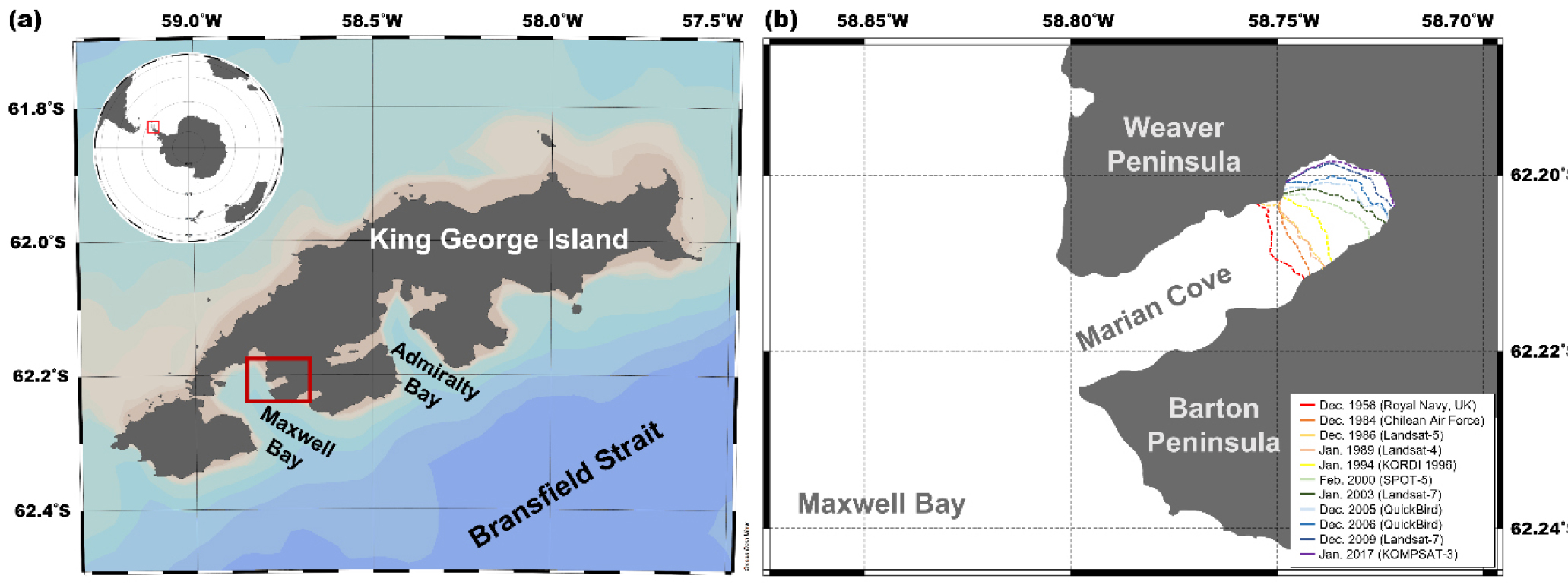
남극 킹조지섬(King George Island) 서부에 위치한 마리안 소만(Marian Cove)은 U자형 피오르드(fjord) 지형을 지닌 반폐쇄형 해역으로, 지리적·생태학적으로 장기 현장 관측에 매우 적합한 조건을 갖추고 있다(Fig. 1; Rückamp et al., 2011; Lee et al., 2015; Ahn et al., 2021; Jeon et al., 2021; Mascioni et al., 2021). 위버 반도(Weaver Peninsula)와 바튼 반도(Barton Peninsula)로 인해 외해와 부분적으로 격리되어 있으며, 인접한 빙하에서 유입되는 융해수가 이 지역의 수온, 염분, 광환경 등 물리적-생지화학적 특성에 뚜렷한 변화를 유도한다. 이러한 지형적·수리적 조건은 마리안 소만을 계절적 및 기후적 요인에 따른 해양 생태계 반응을 시공간적으로 정밀하게 추적할 수 있는 이상적인 ‘자연 실험실’로 기능하게 한다. 선행연구 사례에서 마리안 소만은 식물플랑크톤 군집 구성과 일차생산력이 단기간 내에서도 급격하게 변동하며(Kim et al., 2021; 2022), 마리안 소만 및 인접 연안에서 수행된 여러 연구들은 생산성이 계절, 공간, 그리고 기상 조건에 따라 크게 달라짐을 보고하고 있다(Kang et al., 2002; Schloss et al., 2014; Jeon et al., 2021; Kim et al., 2022). 마리안 소만에서는 최근 미소 식물플랑크톤의 비율 증가, 미생물 먹이망의 강화, 탄소흡수 효율 변화 등이 관측되고 있으며(Garcia et al., 2019; Jeon et al., 2021), 이는 극지 생태계 구조 재편의 초기 신호로 해석되고 있다. 따라서 마리안 소만을 중심으로 한 장기적이고 계절적으로 세분화된 일차생산력 평가는 극지 해양 생태계의 기후 민감성을 이해하는 것을 넘어, 남극 연안의 탄소 생물펌프 기능을 평가하는 데 기여할 수 있다.
https://cdn.apub.kr/journalsite/sites/kso/2025-030-03/N0230300302/images/figure_KSO_30_03_02_F1.jpg
Fig. 1.

Map of King George Island, Western Antarctic Peninsula. (a) and (b) show the locations of Maxwell Bay and Marian Cove, respectively. Glacier boundaries were delineated from satellite imagery and aerial photographs (Kim et al., 2021).

본 종설은 마리안 소만에서 관측된 식물플랑크톤 일차생산력과 군집 구조의 시공간적 변동성을 조절하는 주요 환경 요인의 역할을 통합적으로 고찰한다. 마리안 소만은 WAP 연안의 주요 피오르드 지역들과 유사한 물리적‧지형학적 조건을 공유한다는 점에서 이 지역에서 나타나는 생태계 변동의 경향성을 이해하는 데 의미 있는 단서를 제공한다. 따라서 이러한 국지적 사례를 WAP 연안 생태계의 맥락에서 해석함으로써, 기후 변화에 따른 극지 해양 생태계의 반응 메커니즘을 밝히고, 나아가 남극 연안 생태계 연구 및 전 지구적 탄소 순환 예측 모델에 기여할 수 있는 과학적 기반을 마련하고자 한다.

2. 마리안 소만에서 관측된 남극 식물플랑크톤 군집 및 일차생산력의 시공간적 변동

마리안 소만은 다양한 환경 요인이 복합적으로 작용하여 생산성과 군집 구조가 빠르게 변화하는 고변동성 연안 생태계로, 남극 해역의 기후변화 민감도와 탄력성을 평가할 수 있는 생태계 지표로서의 활용 가능성이 높다(Kang et al., 2002; Ducklow et al., 2013; Kim et al., 2022). 마리안 소만과 인근 해역에서 식물플랑크톤 군집과 일차생산력은 뚜렷한 시·공간적 변동성을 보이며(Table 1), 이는 빙하 융해수의 유입, 수층의 안정화, 광 환경의 변화 등 복합적인 환경 요인에 의해 조절된다(Schloss et al., 2014; Jeon et al., 2021; Mascioni et al., 2021; Kim et al., 2022). 마리안 소만의 식물플랑크톤 엽록소-a (chlorophyll-a) 농도와 탄소흡수율은 여름철(11월 말-2월) 해빙 소멸과 일사량 증가로 인해 상승하며, 대개 1월 중순에서 말 사이에 최댓값이 관측된다(Kang et al., 2002; Lee et al., 2015; Kim et al., 2021). Lee et al.(2015)은 1996-2008년 장기 관측에서 마리안 소만의 연평균 엽록소-a 농도가 0.57±0.59 mg m⁻³였으며, 국지적 조건에 따라 최대 일일 농도가 37.0 mg m⁻³까지 증가하였다고 보고하였다. 마리안 소만에서는 환경 조건의 급변에 따라 식물플랑크톤 생물량이 수일 내 급격히 변동할 수 있다. 특히 강한 동풍이 지속될 경우 수층 불안정화로 인해 엽록소-a 농도와 생산성이 급감하며(Kim et al., 2022; 2023), 이는 마리안 소만의 식물플랑크톤 군집이 물리환경 변화에 매우 민감하게 반응함을 보여준다(Jeon et al., 2021; 2023).

Table 1.

Summary of reported phytoplankton primary production and chlorophyll-a concentrations in coastal regions of the Western Antarctic Peninsula and adjacent straits. Primary production is expressed as g C m⁻² day⁻¹; chlorophyll-a as mg m⁻³, or mg m⁻² for depth-integrated values where noted. Data were compiled from multiple studies spanning different years and seasons. “n/a” denotes data not available

Region Period Primary production Chlorophyll-a Ref.
(g C m⁻² day⁻¹) (mg m-3)
Western Antarctic Peninsula 0.45 n/a (1)
Andvord Bay, Gerlache Strait 2015 spring (Nov-Dec) 0.30-3.56 1.95±1.31 (2)
Andvord Bay, Gerlache Strait 2016 autumn (Apr) 0.04-0.19 1.95±1.31 (2)
Gerlache Strait 0.73-3.58 0.5-2.0 (3)
Bransfield Strait 0.68-2.90 0.5-2.0 (3)
Marguerite Bay 0.10-6.91 1.2-4.0 (4)
Gerlache-Bransfield Strait 1996 Jan 0.70-3.20 n/a (5)
Gerlache Strait 1995 Dec-1996 Feb 2.10 165 mg m-2 (6)
Bransfield Strait 1995 Dec-1996 Feb 1.00 62.0 mg m-2 (6)
Maxwell Bay 2017 summer (Jan-Feb) 1.29-8.83 max: 29.2 (7)
Marian Cove 2019 summer (Jan-Feb) 0.01-4.52 1-2 (8)

공간적으로는 빙하와 인접한 내측 해역과 외측 개방 해역 간의 명확한 군집 및 일차생산력 차이가 보고되었다. 내측 해역은 빙하 융해수에 수반되어 담수와 부유물질(suspended particulate matter, SPM)이 유입됨에 따라 저염도(28-32 psu) 및 광 제한 환경이 조성된다. 이에 따라 내측에서는 은편모조류와 같은 소형 편모조류(flagellates)가 우점하며 낮은 일차생산력이 나타난다(Kim et al., 2021; Jeon et al., 2021; 2023). 반면, 외측 해역은 상대적으로 높은 염도(34-35 psu)와 낮은 탁도 환경에서 대형 규조류가 우점하여 상대적으로 높은 생산성이 유지된다(Kim et al., 2021; Jeon et al., 2021; 2023). 이러한 내측-외측 간 물리적 이질성과 그에 따른 군집 및 생산성의 차이는 인근의 포터 소만(Potter Cove), 안드보르 만(Andvord Bay), 호프 만(Hope Bay) 등과도 일치하는 경향을 보이며, WAP 연안 생태계에서 공간적 환경 차이에 따라 식물플랑크톤 군집 구조와 일차생산력이 민감하게 조절될 수 있음을 시사한다(Garcia et al., 2019; Mascioni et al., 2019; Ferreira et al., 2020; Pan et al., 2020).

3. 서남극 반도에서 식물플랑크톤 군집 및 일차생산력 변동에 영향을 미치는 환경요인

3.1 영양염 역학

남극 해양은 일반적으로 질산염(NO3⁻), 인산염(PO4³⁻), 규산염(SiO2) 등의 무기 영양염이 표층에 풍부하게 존재함에도 불구하고, 식물플랑크톤의 생물량이 낮아 HNLC (high nutrient, low chlorophyll) 해역으로 분류된다. 이러한 저생산성은 철(Fe)의 제한, 광의 부족, 섭식압(feeding pressure) 등의 복합적인 환경 요인에 기인한다(Banse, 1996; Boyd et al., 2001; Hiscock et al., 2003). 이에 반해, WAP 연안은 해빙 융해, 남극 심층수의 용승, 빙하 기원 담수의 유입 등 다양한 경로를 통해 질산염, 인산염, 규산염이 지속적으로 공급되며 대륙붕 퇴적물과 재부유된 입자, 인근 육상으로부터 공급된 철 농도도 상대적으로 높게 나타난다(Bown et al., 2018; Forsch et al., 2021). 마거리트 만(Marguerite Bay)과 같은 남극 연안 해역에서는 철과 같은 생물학적 미량금속(trace metals)의 공급이 식물플랑크톤 성장을 제한하지 않는 것으로 보고되었다(Annett et al., 2015; Bown et al., 2017). 이러한 이유로 WAP 연안은 고영양염-고생산성 해역의 특성을 나타내며, 규조류 등 대형 식물플랑크톤이 우점하고 높은 일차생산력과 생물량이 유지된다(Garibotti et al, 2005; Henley et al., 2018).

마리안 소만에서 Kang et al.(2002)은 봄철(11-12월) Fragilaria striatulaLicmophora belgicae 등의 규조류가 급증하여 전체 엽록소-a의 약 45%를 차지하며, 이 시기의 질산염 농도(12-14 μM)와 규산염 농도(30-43 μM)가 높게 유지됨을 보고하였다. 또한 규조류 생물량과 영양염 농도 간의 음의 상관관계를 통해 규조류의 높은 영양염 요구량을 확인하였다. 여름철에는 해빙 융해로 인한 담수 유입이 수온 상승과 염분 저하를 초래하여 은편모조류와 같은 소형 종의 성장이 촉진되는 경향이 나타난다(Mendes et al., 2018; Pan et al., 2020). 식물플랑크톤 군집별 영양염 활용 전략의 차이는 마리안 소만의 군집 구성에 중요한 영향을 미친다. 규조류는 질산염과 규산염에 대한 높은 요구량 및 빠른 성장률을 바탕으로 고영양-고광 조건에서 경쟁적 우위를 점한다(Falkowski et al., 1998; Arrigo, 2005). 반면, 은편모조류는 낮은 질소 농도에서도 암모늄(NH4+)을 선호하며 빠르게 흡수하고, 혼합영양(mixotrophic) 전략을 통해 저광 환경에서도 생존이 가능하다(Stoecker and Lavrentyev, 2018; Pan et al., 2020). 또한 극지 녹조류 및 초미소플랑크톤(picoplankton)은 낮은 영양염 요구량과 높은 표면적 대 부피 비율을 통해 영양염 농도가 낮은 환경에 적응하며, 이러한 군집은 탄소 유출 경로 및 생물학적 펌프 내에서 서로 다른 생태학적 역할을 수행한다(Morgan-Kiss et al., 2006).

Pan et al.(2020)은 안드보르 만에서 12월 표층 질산염 농도가 평균 28.55 μM에 달하고, 활강풍(katabatic wind) 발생 시 영양염이 풍부한 물이 빙하 전면에서 용승되는 현상을 관측하였다. 그러나 높은 질산염과 철 농도에도 불구하고 규조류가 우점하지 않았으며, 이는 빛 제한, 성층화, 섭식압과 같은 다른 제한 요인이 존재함을 시사한다. Mascioni et al.(2021)은 게를라슈 해협(Gerlache Strait)과 안드보르 만에서 규조류 우점기에 일차생산력이 최대 3.25 g C m⁻² d⁻¹ (평균 1.95±1.31 g C m⁻² d⁻¹)까지 증가함을 보고하였으며, 군집 구조 차이를 설명하는 주요 변수로 영양염 농도를 제시하였다. 또한 가을철 와편모조류(dinoflagellates) 우점은 가장 낮은 영양염 농도와 관련되어 대발생 이후(post-bloom)의 상태를 반영하였으며, 여름철 규조류가 높은 영양염을 소진했을 가능성을 제시하였다.

결론적으로, 서남극반도 연안에서의 식물플랑크톤 군집 구조 및 일차생산력은 무기 영양염의 농도, 공급 경로, 수직 혼합 등 다양한 물리·화학적 요인에 의해 복합적으로 조절된다. 식물플랑크톤 군집별 생리적 특성과 영양염 활용 전략은 군집 구성과 탄소 고정 효율성을 동적으로 변화시키며, 이는 극지 해양 생태계의 탄소 순환 및 에너지 흐름 이해에 중요한 생태학적 시사점을 제공한다.

3.2 광 가용성(light availability)

WAP 해역에서 식물플랑크톤의 광 가용성(light availability)은 이들의 군집 구조 및 일차생산력 변동에 중요한 요인으로 작용한다(Vernet et al., 2008; Carvalho et al., 2016). 특히, 빙하 융해에서 기인한 SPM은 수층의 탁도를 증가시켜 투과되는 광을 강하게 제한하는 것으로 보고되었다(Dierssen et al., 2002; Garcia et al., 2019; Kim et al., 2022). 빙하 융빙수의 유입은 무기 영양염과 철을 공급하여 식물플랑크톤의 급속한 성장을 유도하기도 하지만(Kim et al., 2016; Pan et al., 2025), 융빙이 지속되면 수층 안정화와 광 투과도 감소가 동반되어 미소 식물플랑크톤이 우점하는 군집 구조로의 전환이 나타난다(Garcia et al., 2019; Pan et al., 2020). 이와 유사하게 마리안 소만의 여름철 현장관측 결과에서도 낮은 SPM 농도와 높은 광 투과성이 나타난 외측 해역에서는 대형 규조류가 우점하며 일차생산력이 4.52 g C m⁻² day⁻¹로 나타났다(Kim et al., 2021). 반면, SPM 농도가 높은 내측에서는 미소 편모조류가 우점하며 일차생산력이 낮게 관찰되었다(Kim et al., 2021; Jeon et al., 2021; 2023). 이는 탁한 빙하 융해수의 유입이 심화되면서 SPM 농도가 최대 42 g m-3까지 증가하여, 표층 5 m 이내에서 대부분의 가시광선이 소멸되는 강한 광 제한 환경이 조성된 결과로 해석된다(Kim et al., 2021). Jeon et al.(2021)은 2010년 마리안 소만의 예외적 대규모 규조류 대발생(bloom) 시기에도 탁도 증가에 따라 군집이 빠르게 재편된 결과를 보고하였으며, Garcia et al.(2019)은 포터 소만에서 외측과 내측 해역 간 SPM과 광 환경에 따른 생산성과 군집 구조의 차이를 분석하였다. Montes-Hugo et al.(2009)은 위성 기반 장기 모니터링을 통해, WAP 북부 해역에서 지난 30년간 생산성이 최대 89% 감소하였으며, 이와 함께 광환경 악화로 인해 군집 구조가 대형종에서 소형 식물플랑크톤으로 전환되었음을 밝혔다. 최근 연구들은 광량, 유광층 깊이, 수층 혼탁도가 식물플랑크톤의 크기 구조 및 일차생산력의 변화를 통해 탄소 유출 효율(carbon export efficiency)에 직접적인 영향을 미치는 주요 물리적 조절 변수임을 보여주고 있다(Schloss et al., 2012; Schofield et al., 2017; Mascioni et al., 2019; Kim et al., 2021).

WAP에서 바람은 단기적으로 수괴의 혼합을 유발하고 장기적으로는 해빙 농도를 조절하여 식물플랑크톤 군집 구조 및 일차생산력에 영향을 끼치는 매우 중요한 요소이다(Montes-Hugo et al., 2009; Schofield et al., 2010; Höfer et al., 2019). 마리안 소만, 포터 소만, 애드미럴티 만(Admiralty Bay) 등과 같은 수심이 얕은 소규모의 만에서는 급격한 풍속 및 풍향의 변화가 수괴의 강한 연직 혼합을 유발하여 연안 용승으로 이어질 수 있다(Brandini and Rebello, 1994; Schloss et al., 2014; Kim et al., 2023). 이와 같이 잘 혼합된(well-mixed) 연직 구조를 통해 수층 내로 저서성 규조류(benthic diatoms) 등 크기가 큰 식물플랑크톤이 유입되어 일시적으로 생체량과 일차생산력이 높아진 결과가 다수 보고된 바 있다(Brandini and Rebello, 1994; Jeon et al., 2021; 2023). 반면, Schloss et al.(2002)은 해당 지역에서 식물플랑크톤의 생장이 가능하기 위해서는 최소 12-15일 동안 풍속이 4 m s-1 이하로 유지되는 안정한 조건이 필요하다고 제시하였다. 이러한 연구 결과들은 수심이 얕은 WAP 해역에서는 바람에 의한 수직 혼합과 이에 따른 광 가용성이 식물플랑크톤의 생물량 축적을 제한하는 핵심적인 요인으로 작용함을 시사한다.

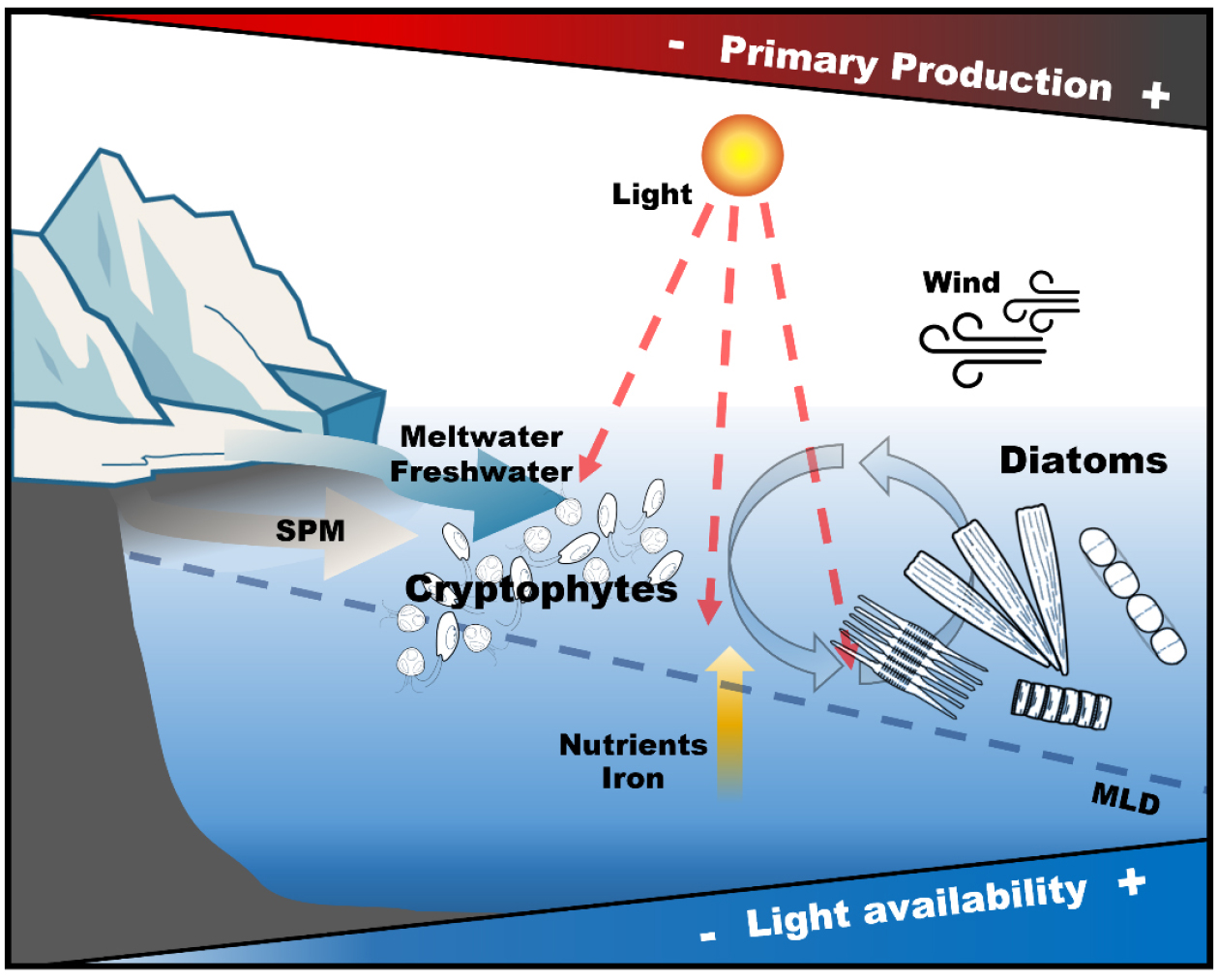
바람에 의해 크게 변동하는 혼합층 깊이(mixed layer depth, MLD)는 식물플랑크톤의 유광층 내 체류 시간을 조절하기 때문에 광 가용성과 밀접한 연관이 있다(Vernet et al., 2008; Carvalho et al., 2016). Vernet et al.(2008)은 WAP 대륙붕 지역에서 일차생산력이 250-1100 mg C m⁻² day⁻¹ 범위로 크게 변동하며, 대륙사면으로 갈수록 점진적으로 감소하는 뚜렷한 연안-외해(onshore-offshore) 구배가 존재함을 보고하였다. 이는 대륙사면에 비해 MLD가 얕은 WAP 연안 해역에서 광 가용성이 개선되어 식물플랑크톤 생장에 유리한 환경이 조성된 결과로 해석되었다. 완만한 바람 조건에서 형성되는 얕은 MLD와 안정된 수괴구조는 식물플랑크톤이 광합성에 유리한 상층부에 장시간 체류할 수 있게 하며, 이로 인해 일차생산력이 향상될 수 있다(Vernet at al., 2008; Schloss et al., 2014; Carvalho et al., 2016; Höfer et al., 2019). 수괴구조의 성층과 이에 따른 광량의 증가는 광 흡수량 및 영양염 요구량이 높은 규조류의 번성을 촉진한다(Fragoso and Smith, 2012). 그러나 얕은(깊은) MLD가 반드시 높은(낮은) 일차생산력과 규조류의 우점으로 이어지는 것은 아니다. Mendes et al.(2018)은 융빙수의 유입과 강한 성층화로 MLD가 20 m 내외로 얕아졌을 경우, 은편모조류와 같은 소형 종들이 우점하고 오히려 일차생산력이 저해될 수 있음을 보고하였다. 이에 반해 깊은 MLD를 통한 수직혼합을 통해 영양염과 철이 상층부에 공급되어 생물량이 증가하기도 한다(Zhang et al., 2020). 이처럼 남극 연안 생태계는 빙하 융해수 유입, 바람 방향 및 강도, MLD 등 복합적 환경 요인의 상호 작용에 따라 식물플랑크톤의 군집 구조 및 생산성이 결정된다(Fig. 2; Ducklow et al., 2013; Deppeler and Davidson, 2017; Schofield et al., 2017). 따라서 식물플랑크톤 변동을 이해하고 예측하기 위해서는 단일 인자 분석을 넘어 다차원적인 접근이 필요하다.
https://cdn.apub.kr/journalsite/sites/kso/2025-030-03/N0230300302/images/figure_KSO_30_03_02_F2.jpg
Fig. 2.

Schematic of key environmental drivers of phytoplankton community structure and primary production in the Western Antarctic Peninsula. SPM, suspended particulate matter; MLD, mixed-layer depth.

3.3 남극환상진동(Southern Annular Mode)

남극환상진동(Southern Annular Mode, SAM)은 남반구 고위도 지역의 대기 및 해양 순환을 지배하는 주요 기후 인덱스로, 중위도와 고위도 간의 기압 차에 기반하여 정의된다(Marshall, 2003; 2007). SAM의 음(negative) 및 양(positive) 위상은 남극 서풍대(southern westerly winds)의 위치 및 강도와 밀접한 관련이 있으며, 이는 WAP 해역의 수온과 열 수지(heat budget)의 변화로 이어진다(Wang et al., 2022). 겨울철 음의 SAM의 위상이 나타날 경우, WAP지역의 차가운 남풍이 유발되어 해빙 농도를 증가시키고 이로 인해 여름철 식물플랑크톤이 크게 번성할 수 있는 안정된 수괴 구조가 형성된다(Saba et al., 2014). 반면, 양의 SAM 위상일 경우 강화된 서풍대가 남쪽으로 이동하고 지역적인 기압차에 의해 따뜻한 공기가 WAP지역에 유입된다(Lefebvre et al., 2004; Turner et al., 2014; Deng et al., 2022). 1950년대 이후 연평균 SAM 위상은 큰 연간변동성에도 불구하고, 전 지구적 온난화 및 성층권 오존 변화의 영향으로 점진적인 양의 추세를 보여왔다(Fogt and Marshall, 2020; Zhang et al., 2020). 특히 2010년 이후에는 양의 SAM 위상이 지속되면서 WAP 해역의 해양 환경과 생물생산성에 중대한 변화를 초래하고 있다(Zhang et al., 2020; Ferreira et al., 2024).

WAP 연안에서 양의 SAM 위상에 의해 강화된 동서바람(zonal wind)은 상대적으로 따뜻한(~2°C) 남극순환심층수(Circumpolar Deep Water, CDW)의 용승을 유발하여 해양 상층부의 혼합을 촉진하고 해빙의 후퇴를 가속화한다(Fogt and Marshall, 2020). 침투된 CDW는 용존철(dissolved Fe), 질산염, 인산염 등 미량 및 다량 무기 영양염을 표층으로 공급할 수 있으며, Zhang et al.(2020)은 남셰틀랜드 군도(South Shetland Islands) 해역에서 연간 SAM 지수와 CDW 침투 범위 사이의 유의한 양의 상관계수(r=0.71, p=0.01)가 있음을 보고하였다. 이러한 해양의 물리‧화학적 환경 변화는 식물플랑크톤의 일차생산력에 직접적인 영향을 미친다. Zhang et al.(2020)의 보고에 따르면, SAM 지수와 표층 엽록소-a 농도는 엘리펀트 섬(Elephant Island) 및 남셰틀랜드 군도 지역 모두에서 높은 상관관계를 보였으며, SAM 양의 위상이 강화된 연도에는 엽록소-a 농도가 64-150 mg m⁻² 이상으로 높게 유지되었다. 이는 단순한 생물량 증가를 넘어, 광합성 탄소 고정률의 계절적, 공간적 확대를 의미한다. 이에 더해 Ferreira et al.(2024)은 1998-2022년 기간 동안 WAP 해역의 엽록소-a 농도가 전반적으로 증가 추세를 보였으며, 특히 브랜스필드 해협(Bransfield Strait)에서는 0.027 mg m⁻³ yr⁻¹의 증가율이 나타났다고 보고하였다. 이러한 변화는 양의 SAM 위상 강화에 따라 해빙 시기가 지연되고, 해수 온도 및 광 조건이 상대적으로 안정화된 결과로 해석된다.

그러나 WAP 연안은 지형적 복잡성과 강한 지역적 이질성을 지니고 있어, 양의 SAM 위상이 미치는 영향은 공간적으로 차이를 보인다(Ferreira et al., 2024). CDW의 용승은 영양염을 공급함과 동시에 해빙 후퇴 및 융빙수의 유입을 초래하여(Fogt and Marshall, 2020), WAP 연안에서 은편모조류 및 초미소식물플랑크톤이 번성할 수 있는 환경을 제공한다(Ferreira et al., 2024). 최근 연구들을 통해 WAP 연안에서 크기가 큰 원형 규조류(centric diatoms) 중심의 군집구조에서 크기가 작은 은편모조류 중심으로 전환되는 경향이 다수 보고된 바 있다(Mendes et al., 2018; Mascioni et al., 2021; Costa et al., 2023). 이러한 식물플랑크톤 군집의 구성 및 크기 구조 변화는 중간 소비자인 크릴(Euphausia superba)을 통해 상위 포식자인 펭귄류 및 고래류의 섭식 전략 및 개체군 역학에도 파급 효과를 미친다(Schofield et al., 2017). 따라서 SAM은 WAP 연안 해양 생태계의 시공간적 생산성과 구조적 기능을 조절하는 주요 기후 인자로 작용할 수 있으며, 향후 기후 시나리오에 따른 생태계 반응을 예측하기 위해 SAM의 역할을 정량적으로 평가하는 것이 필수적이다.

4. 결 론

WAP는 지구상에서 가장 빠르게 온난화가 진행되는 지역 중 하나로, 향후 수십 년 동안 생태계 전반에 걸쳐 심각한 변동이 예상된다(Moreau et al., 2015; Schofield et al., 2017; Ferreira et al., 2024). 기후 모델과 관측 연구를 종합한 결과, 이 지역의 연평균 기온은 2100년까지 최대 2.5°C 이상 상승할 것으로 예측되며, 해빙 지속 기간은 연간 약 60-90일 더 단축될 것으로 보인다. WAP 연안에서의 식물플랑크톤 군집구조와 일차생산력의 변동은 이러한 기후 변화에 따른 수층 내 물리 및 화학적 인자 변화가 종합적으로 반영된 결과로 해석된다. 최근 연구는 해빙 감소 및 빙하 융해수 유입 증가로 인한 수층 안정성 강화와 광 조건 개선이 식물플랑크톤의 성장 기간을 연장하며, 이로 인해 봄철과 가을철 대발생 빈도가 증가할 것으로 예측하고 있다(Ferreira et al., 2024). 그러나 일차생산력의 증가는 생태계 전체의 안정성과 기능적 균형을 반드시 보장하지 않는다. 장기 관측 결과, 과거 규조류가 우점하는 군집은 최근 수년간 은편모조류와 Phaeocystis antarctica와 같은 미소플랑크톤이나 높은 광에 적응한 종으로 전환되는 경향을 보이며, 이러한 변화는 전통적인 크릴 중심 먹이망을 더욱 복잡한 미세섭식 기반 네트워크로 재편할 가능성을 시사한다(Schofield et al., 2017; Garcia et al., 2019; Mascioni et al., 2021). 식물플랑크톤 군집 재편성은 식물플랑크톤 종 조성의 변화가 2차 소비자를 거쳐 상위 포식자까지 연쇄적으로 영향을 미침을 의미한다(Ducklow et al., 2013; Saba et al., 2014; Schofield et al., 2017). 식물플랑크톤 군집의 구조적 변화는 먹이망 내 에너지 전달 효율을 저하시킬 수 있으며, 이는 크릴과 같은 중간 소비자의 가용성에 영향을 미쳐 궁극적으로 펭귄, 바다표범, 고래와 같은 상위 포식자의 번식 성공률과 개체군 안정성에 부정적 영향을 초래할 수 있다(Ducklow et al., 2007; Sailley et al., 2013). 또한, 탄소 고정 및 침강 메커니즘에 직접적인 영향을 미치며, 생물학적 탄소 펌프의 효율성을 저하시킬 수 있다. 대형 규조류 중심 군집은 빠른 침강 경로를 통해 탄소를 심층으로 격리하는 데 효과적이지만(Smetacek et al., 2012), 소형 플랑크톤이 우점하는 경우 표층에서의 탄소 재순환 비율이 증가하여 대기-해양 간 이산화탄소 교환이 촉진된다(Falkowski et al., 1998). 이는 미생물 고리(microbial loop)의 활성화와 연관되어 장기적인 탄소 격리 능력을 약화시킨다(Legendre and Le Févre, 1995).

향후 연구에서는 단순한 생물량 기반의 일차생산력 추정을 넘어서, 식물플랑크톤 군집의 구조적 특성, 생리적 반응, 무기 영양염의 변화, 먹이망 내 에너지 전달 경로, 그리고 탄소 및 질소 순환에의 기여도를 통합적으로 분석할 수 있는 종합적 모델링 접근이 요구된다. 따라서, WAP 해역의 공간적 이질성과 계절적 변동성을 반영한 장기 생태계 모니터링 체계를 구축하여 기후 변화에 따른 해양 생태계의 반응을 정량적으로 예측하고, 효과적인 보전 및 관리 전략을 수립하여야 할 것이다.


Acknowledgements

본 연구는 한국해양과학기술원 부설 극지연구소 기관고유사업 “서남극해 온난화에 따른 탄소흡수력 변동 및 생태계 반응 연구(PE25110)”의 지원을 받아 수행되었습니다.

References

1

Ahn, I.-Y., F. Elias-Piera, S.-Y. Ha, S. Rossi and D.-U. Kim, 2021. Seasonal dietary shifts of the gammarid amphipod Gondogeneia antarctica in a rapidly warming fjord of the West Antarctic Peninsula. J. Mar. Sci. Eng., 9: 1447. DOI: https://doi.org/10.3390/jmse9121447.

10.3390/jmse9121447
2

Annett, A.L., M. Skiba, S.F. Henley, H.J. Venables, M.P. Meredith, P.J. Statham and R.S. Ganeshram, 2015. Comparative roles of upwelling and glacial iron sources in Ryder Bay, coastal western Antarctic Peninsula. Mar. Chem., 176: 21-33. DOI: https://doi.org/10.1016/j.marchem.2015.06.017.

10.1016/j.marchem.2015.06.017
3

Arrigo, K.R., 2005. Marine microorganisms and global nutrient cycles. Nature, 437: 349-355. DOI: https://doi.org/10.1038/nature04159.

10.1038/nature04159
4

Banse, K., 1996. Low seasonality of low concentrations of surface chlorophyll in the Subantarctic water ring: underwater irradiance, iron, or grazing? Prog. Oceanog., 37: 241-291. DOI: https://doi.org/10.1016/S0079-6611(96)00006-7.

10.1016/S0079-6611(96)00006-7
5

Bown, J., H. van Haren, M.P. Meredith, H.J. Venables, P. Laan, J.A. Brearley and H.J.W. de Baar, 2018. Evidences of strong sources of DFe and DMn in Ryder Bay, Western Antarctic Peninsula. Phil. Trans. R. Soc. A, 376: 20170172. DOI: http://dx.doi.org/10.1098/rsta.2017.0172.

10.1098/rsta.2017.017229760115PMC5954471
6

Bown, J., P. Laan, S. Ossebaar, K. Bakker, P. Rozema and H.J.W. de Baar, 2017. Bioactive trace metal time series during Austral summer in Ryder Bay, Western Antarctic Peninsula. Deep-Sea Res. Ⅱ, 139: 103-119. DOI: https://doi.org/10.1016/j.dsr2.2016.07.004.

10.1016/j.dsr2.2016.07.004
7

Boyd, P.W., A.C. Crossley, G.R. DiTullio, F.B. Griffiths, D.A. Hutchins, B. Queguiner, P.N. Sedwick and T.W. Trull, 2001. Control of phytoplankton growth by iron supply and irradiance in the subantarctic Southern Ocean: Experimental results from the SAZ project. J. Geophy. Res., 106: 31573-31583. DOI: https://doi.org/10.1029/2000JC000348.

10.1029/2000JC000348
8

Brandini, F.P. and J. Rebello, 1994. Wind field effect on hydrography and chlorophyll dynamics in the coastal pelagial of Admiralty Bay, King George Island, Antarctica. Antarct. Sci., 6(4): 433-442. DOI: https://doi.org/10.1017/S0954102094000672.

10.1017/S0954102094000672
9

Carvalho, F., J. Kohut, M.J. Oliver, R.M. Sherrell and O. Schofield, 2016. Mixing and phytoplankton dynamics in a submarine canyon in the West Antarctic Peninsula. J. Geophys. Res. Oceans, 121: 5069-5083. DOI: http://doi.org/10.1002/2016JC011650.

10.1002/2016JC011650
10

Cook, A.J., P.R. Holland, M.P. Meredith, T. Murray, A. Luckman and D.G. Vaughan, 2016. Ocean forcing of glacier retreat in the western Antarctic Peninsula. Science, 353: 283-286. DOI: http://doi.org/10.1126/science.aae0017.

10.1126/science.aae0017
11

Costa, R.R., A. Ferreira, M.S. de Souza, V.M. Tavano, R. Kerr, E.R. Secchi, V. Brotas, T.S. Dotto, A.C. Brito and C.R.B. Mendes, 2023. Physical-biological drivers modulating phytoplankton seasonal succession along the Northern Antarctic Peninsula. Environ. Res., 231: 116273. DOI: https://doi.org/10.1016/j.envres.2023.116273.

10.1016/j.envres.2023.116273
12

Cox, P.M., R.A. Betts, C.D. Jones, S.A. Spall and I.J. Totterdell, 2000. Acceleration of global warming due to carbon-cycle feedbacks in a coupled climate model. Nature, 408: 184-187. DOI: https://doi.org/10.1038/35041539.

10.1038/35041539
13

Deng, K., C. Azorin-Molina, S. Yang, C. Hu, G. Zhang, L. Minola and D. Chen, 2022. Changes of Souther Hemisphere westerlies in the future warming climate. Atmos. Res., 270: 106040. DOI: https://doi.org/10.1016/j.atmosres.2022.106040.

10.1016/j.atmosres.2022.106040
14

Deppeler, S.L. and A.T. Davidson, 2017. Southern Ocean phytoplankton in a changing climate. Front. Mar. Sci., 4: 40. DOI: http://doi.org/10.3389/fmars.2017.00040.

10.3389/fmars.2017.00040
15

Dierssen, H.M., R.C. Smith and M. Verner, 2002. Glacial meltwater dynamics in coastal waters west of the Antarctic peninsula. Proc. Natl. Acad. Sci. U.S.A., 99: 1790-1795. DOI: https://doi.org/10.1073/pnas.032206999.

10.1073/pnas.03220699911830636PMC122272
16

Ducklow, H.W., A. Clarke , R. Dickhut, S.C. Doney, H. Geisz, K. Huang, D.G. Martinson, M.P. Meredith, H.V. Moeller, M. Montes-Hugo, O. Schofield, S.E. Stammerjohn, D.K. Steinberg and W. Fraser, 2012. The marine system of the Western Antarctic Peninsula. In: Antarctic ecosystems: An extreme environment in a changing world, edited by Rogers, A.D., N.M. Johnston, E.J. Murphy, and A. Clarke, Blackwell, London, pp. 121-159.

10.1002/9781444347241.ch5
17

Ducklow, H.W., K. Baker, D.G. Martinson, L.B. Quetin, R.M. Ross, R.C. Smith, S.E. Stammerjohn, M. Vernet and W. Fraser, 2007. Marine pelagic ecosystems: the West Antarctic Peninsula. Phil. Trans. R. Soc. B, 362: 67-94. DOI: https://doi.org/10.1098/rstb.2006.1955 06.1955.

10.1098/rstb.2006.195517405208PMC1764834
18

Ducklow, H.W., W.R. Fraser, M.P. Meredith, S.E. Stammerjohn, S.C. Doney, D.G. Martinson, S.F. Sailley, O.M. Schofield, D.K. Steinberg, H.J. Venables and C.D. Amsler, 2013. West Antarctic Peninsula: An ice-dependent coastal marine ecosystem in transition. Oceanography, 26: 190-203. DOI: https://doi.org/10.5670/oceanog.2013.62.

10.5670/oceanog.2013.62
19

Falkowski, P.G., R.T. Barber and V. Smetacek, 1998. Biogeochemical controls and feedbacks on ocean primary production. Science, 281: 200-207. DOI: https://doi.org/10.1126/science.281.5374.200.

10.1126/science.281.5374.200
20

Ferreira, A., C.R.B. Mendes, R.R. Costa, V. Brotas, V.M. Tavano, C.V. Guerreiro, E.R. Secchi and A.C. Brito, 2024. Climate change is associated with higher phytoplankton biomass and longer blooms in the West Antarctic Peninsula. Nat. Commun., 15: 6536. DOI: https://doi.org/10.1038/s41467-024-50381-2.

10.1038/s41467-024-50381-239095339PMC11297178
21

Ferreira, A., R.R. Costa, T.S. Dotto, R. Kerr, V.M. Tavano, A.C. Brito, V. Brotas, E.R. Secchi and C.R.B. Mendes, 2020. Changes in phytoplankton communities along the Northern Antarctic Peninsula: Causes, impacts and research priorities. Front. Mar. Sci., 7: 576254. DOI: https://doi.org/10.3389/fmars.2020.576254.

10.3389/fmars.2020.576254
22

Fogt, R.L. and G.J. Marshall, 2020. The Southern Annular Mode: variability, trends, and climate impacts across the Southern Hemisphere. Wiley Interdisciplinary Reviews: Climate Change. 11: e652. DOI: https://doi.org/10.1002/wcc.652.

10.1002/wcc.652
23

Forsch, K.O., L. Hahn-Woernle, R.M. Sherrell, V.J. Roccanova, K. Bu, D. Burdige, M. Vernet and K.A. Barbeau, 2021. Seasonal dispersal of fjord meltwaters as an important source of iron and manganese to coastal Antarctic phytoplankton. Biogeosciences, 18: 6349-6375. DOI: https://doi.org/10.5194/bg-18-6349-2021.

10.5194/bg-18-6349-2021
24

Fragoso, G.M. and W.O. Smith, 2012. Influence of hydrography on phytoplankton distribution in the Amundsen and Ross Seas, Antarctica. J. Mar. Syst., 89: 19-29. DOI: https://doi.org/10.1016/j.jmarsys.2011.07.008.

10.1016/j.jmarsys.2011.07.008
25

Frölicher, T.L., J.L. Sarmiento, D.J., Paynter, J.P. Dunne, J.P. Krasting and M. Winton, 2015. Dominance of the Southern Ocean in anthropogenic carbon and heat uptake in CMIP5 models. J. Climate, 28: 862-886. DOI: https://doi.org/10.1175/JCLI-D-14-00117.1.

10.1175/JCLI-D-14-00117.1
26

Garcia M.D., M.D.F. Severini, C. Spetter, M.C.L. Abbate, M.N. Tartara, E.G. Nahuelhual, J.E. Marcovecchio, I.R. Schloss and M.S. Hoffmeyer, 2019. Effects of glacier melting on planktonic communities of two Antarctic coastal areas (Potter Cove and Hope Bay) in summer. Reg. Stud. Mar. Sci., 30: 100731. DOI: https://doi.org/10.1016/j.rsma.2019.100731.

10.1016/j.rsma.2019.100731
27

Garibotti, I.A., M. Vernet and M.E. Ferrario, 2005. Annually recurrent phytoplanktonic assemblages during summer in the seasonal ice zone west of the Antarctic Peninsula (Southern Ocean). Deep-Sea Res., I, 52: 1823-1841. DOI: https://doi.org/10.1016/j.dsr.2005.05.003.

10.1016/j.dsr.2005.05.003
28

Henley, S.F., E.M. Jones, H.J. Venables, M.P. Meredith, Y.L. Firing, R. Dittrich, S. Heiser, J. Stefels and J. Dougans, 2018. Macronutrient and carbon supply, uptake and cycling across the Antarctic Peninsula shelf during summer. Phil. Trans. R. Soc. A, 376: 20170168. DOI: https://doi.org/10.1098/rsta.2017.0168.

10.1098/rsta.2017.016829760112PMC5954468
29

Hiscock, M.R., J. Marra, W.O. Smith Jr, R. Georicke, C. Measures, S. Vink, R.J. Olson, H.M. Sosik and R.T. Barber, 2003. Primary productivity and its regulation in the Pacific Sector of the Southern Ocean. Deep-Sea Res. II, 50: 533-558. DOI: https://doi.org/10.1016/S0967-0645(02)00583-0.

10.1016/S0967-0645(02)00583-0
30

Höfer, J., R. Giesecke, M.J. Hopwood, V. Carrera, E. Alarcón and H.E. González, 2019. The role of water column stability and wind mixing in the production/export dynamics of two bays in the Western Antarctic Peninsula. Prog. Oceanogr., 174: 105-116. DOI: https://doi.org/10.1016/j.pocean.2019.01.005.

10.1016/j.pocean.2019.01.005
31

Jeon, M., J.L. Iriarte, E.J. Yang, J. Park, C. Alves-de-Souza and S.J. Park, 2023. Importance of nanophytoplankton biomass during summer 2019 in a retreating marine-terminating glacier-fjord system, Marian Cove, West Antarctica (62°S). Front. Mar. Sci., 10: 1174722. DOI: https://doi.org/10.3389/fmars.2023.1174722.

10.3389/fmars.2023.1174722
32

Jeon, M., J.L. Iriarte, E.J. Yang, S.-H. Kang, Y. Lee, H.M. Joo, I.-Y. Ahn, J. Park, G.-S. Min and S.-J. Park, 2021. Phytoplankton succession during a massive coastal diatom bloom at Marian Cove, King George Island, Antarctica. Polar Biol., 44: 1993-2010. DOI: https://doi.org/10.1007/s00300-021-02933-1.

10.1007/s00300-021-02933-1
33

Kang, J.-S., S.-H. Kang, J.H. Lee and S.H Lee, 2002. Seasonal variation of microalgal assemblages at a fixed station in King George Island, Antarctica, 1996. Mar. Ecol. Prog. Ser., 229: 19-32. DOI: https://doi.org/10.3354/meps229019.

10.3354/meps229019
34

Khatiwala, S., F. Primeau and T. Hall, 2009. Reconstruction of the history of anthropogenic CO2 concentrations in the ocean. Nature, 462: 346-349. DOI: http://doi.org/doi:10.1038/nature08526.

10.1038/nature08526
35

Kim, B.K., M. Jeon, H.M. Joo, T.-W. Kim, S.-J. Park, J. Park and S.-Y. Ha, 2021. Impact of freshwater discharge on the carbon uptake rate of phytoplankton during summer in Marian Cove, King George Island, Antarctica. Front. Mar. Sci., 24: 725173. https://doi.org/10.3389/fmars.2021.725173.

10.3389/fmars.2021.725173
36

Kim, B.K., M. Jeon, S.-J. Park, H.-C. Kim, J.-O. Min, J. Park and S.-Y. Ha, 2022. Variability in the carbon and nitrogen uptake rates of phytoplankton associated with wind speed and direction in the Marian Cove, Antarctica. Front. Mar. Sci., 9: 887909. DOI: https://doi.org/10.3389/fmars.2022.887909.

10.3389/fmars.2022.887909
37

Kim, H., H.W. Ducklow, D. Abele, E.M.R. Barlett, A.G.J. Buma, M.P. Meredith, P.D. Rozema, O.M. Scofield, H.J. Venables and I.R. Schloss, 2018. Inter-decadal variability of phytoplankton biomass along the coastal West Antarctic Peninsula. Phil. Trans. R. Soc. A, 376: 20170174. DOI: http://dx.doi.org/10.1098/rsta.2017.0174.

10.1098/rsta.2017.017429760117PMC5954473
38

Kim, H., S.C. Doney, R.A., Iannuzzi, M.P. Meredith, D.G. Martinson and H.W. Ducklow, 2016. Climate forcing for dynamics of dissolved inorganic nutrients at Palmer Station, Antarctica: An interdecadal (1993-2013) analysis. J. Geophys. Res. Biogeosci., 121: 2369-2389. DOI: http://doi.org/10.1002/2015JG003311.

10.1002/2015JG003311
39

Kim, Y., T.-W., Kim, S.-J., Park, S.-Y., Ha, J. Park, J. Yoo and Y.-K. Cho, 2023. Properties and mechanisms of seawater exchange in Marian Cove, King George Island, West Antarctic Peninsula. J. Geophys. Res., 128: e2023JC020111. DOI: http://doi.org/10.1029/2023JC020111.

10.1029/2023JC020111
40

Krumhardt, K.M., M.C. Long, K. Lindsay and M.N. Levy, 2020. Southern Ocean calcification controls the global distribution of alkalinity. Global Biogeochem. Cycles, 34: e2020GB006727. DOI: https://doi.org/10.1029/2020GB006727.

10.1029/2020GB006727
41

Le Quéré, C., C. Rödenbeck, E.T. Buitenhuis, T.J. Conway, R. Langenfelds, A. Gomez, C. Labuschagne, M. Ramonet, T. Nakazawa, N. Metzl, N. Gillett and N. Heimann, 2007. Saturation of the Southern Ocean CO2 sink due to recent climate change. Science, 316: 1735-1738. DOI: http://doi.org/10.1126/science.1136188.

10.1126/science.1136188
42

Lee, S.H., H.M. Joo, H.T. Joo, B.K. Kim, H.J. Song, M. Jeon and S.-H. Kang, 2015. Large contribution of small phytoplankton at Marian Cove, King George Island, Antarctica, based on long-term monitoring from 1996 to 2008. Polar Biol., 38: 207-220. DOI: https://doi.org/10.1007/s00300-014-1579-6.

10.1007/s00300-014-1579-6
43

Lefebvre, W., H. Goosse, R. Timmermann and T. Fichefet, 2004. Influence of the Southern Annular Mode on the sea ice-ocean system. J. Geophys. Res. Oceans, 109: C09005. DOI: https://doi.org/10.1029/2004JC002403.

10.1029/2004JC002403
44

Legendre, L. and J. Le Févre, 1995. Microbial food webs and the export of biogenic carbon in oceans. Aquat. microb. Ecol., 9: 69-77. DOI: https://doi.org/10.3354/ame009069.

10.3354/ame009069
45

Llanillo, P.J., C.M. Aiken, R.R. Cordero, A. Damiani, E. Sepúlveda and B. Fernández-Gómez, 2019. Oceanographic variability induced by tides, the intraseasonal cycle and warm subsurface water intrusions in Maxwell Bay, King George Island (West-Antarctica). Sci. Rep., 9:18571. DOI: https://doi.org/10.1038/s41598-019-54875-8

10.1038/s41598-019-54875-831819101PMC6901452
46

Lorenzo, L.M., B. Arbones, F.G. Figueiras, G.H. Tilstone and F.L. Figueroa, 2002. Photosynthesis, primary production and phytoplankton growth rates in Gerlache and Bransfield Straits during Austral summer: cruise FRUELA 95. Deep-Sea Res., II, 49: 707-721. DOI: https://doi.org/10.1016/S0967-0645(01)00120-5.

10.1016/S0967-0645(01)00120-5
47

Marshall, G.J., 2003. Trends in the Southern Annular Mode from observations and reanalyses. J. Clim., 16: 4134-4143.

10.1175/1520-0442(2003)016<4134:TITSAM>2.0.CO;2
48

Marshall, G.J., 2007. Half-century seasonal relationships between the Southern Annular Mode and Antarctic temperatures. Int. J. Climatol., 27: 373-383. DOI: http://doi.org/10.1002/joc.1407.

10.1002/joc.1407
49

Mascioni, M., G.O. Almandoz, A.O. Cefarelli, A. Cusick, M.E. Ferrario and M. Vernet, 2019. Phytoplankton composition and bloom formation in unexplored nearshore waters of the western Antarctic Peninsula. Polar Biol., 42: 1859-1872. DOI: https://doi.org/10.1007/s00300-019-02564-7.

10.1007/s00300-019-02564-7
50

Mascioni, M., G.O. Almandoz, L. Ekern, B.P. Pan and M. Vernet, 2021. Microplanktonic diatom assemblages dominated the primary production but not the biomass in an Antarctic fjord. J. Mar. Syst., 224: 103624. DOI: https://doi.org/10.1016/j.jmarsys.2021.103624.

10.1016/j.jmarsys.2021.103624
51

Matebr, R.J. and A.C. Hirst, 1999. Climate change feedback on the future oceanic CO2 uptake. Tellus, 51B: 722-733. DOI: https://doi.org/10.1034/j.1600-0889.1999.t01-1-00012.x.

10.1034/j.1600-0889.1999.t01-1-00012.x
52

Mendes, C.R.B., V.M. Tavano, R. Kerr, T.S. Dotto, T. Maximiano and E.R. Secchi, 2018. Impact of sea ice on the structure of phytoplankton communities in the northern Antarctic Peninsula. Deep-Sea Res. II, 149: 111-123. DOI: https://doi.org/10.1016/j.dsr2.2017.12.003.

10.1016/j.dsr2.2017.12.003
53

Meredith, M.P. and J.C. King, 2005. Rapid climate change in the ocean west of the Antarctic Peninsula during the second half of the 20th century. Geophys. Res. Lett., 32: L19604, DOI: https://doi.org/10.1029/2005GL024042.

10.1029/2005GL024042
54

Montes-Hugo, M., S.C. Doney, H.W. Ducklow, W. Fraser, D. Martinson, S.E. Stammerjohn and O. Schofield, 2009. Recent changes in phytoplankton communities associated with rapid regional climate change along the western Antarctic Peninsula. Science, 323: 1470-1473. DOI: https://doi.org/10.1126/science.1164533.

10.1126/science.1164533
55

Moreau, S., B. Mostajir, S. Bélanger, I.R. Schloss, M. Vancoppenolle, S. Demers and G.A. Ferreyra, 2015. Climate change enhances primary production in the western Antarctic Peninsula. Global Change Biol., 21: 2191-2205. DOI: https://doi.org/10.1111/gcb.12878.

10.1111/gcb.12878
56

Morgan-Kiss, R.M., J.C. Priscu, T. Pocock, L. Gudynaite-Savitch and N.P.A. Huner, 2006. Adaptation and acclimation of photosynthetic microorganisms to permanently cold environments. Microbiol. Mol. Biol. Rev., 70: 222-252. DOI: https://doi.org/10.1128/MMBR.70.1.222-252.2006.

10.1128/MMBR.70.1.222-252.200616524924PMC1393254
57

Morley, S.A., D. Abele, D.K.A., Barnes, C.A. Cárdenas, C. Cotté, J. Gutt, S.F. Henley, J. Höfer, K.A. Hughes, S.M. Martin, C. Moffat, M. Raphael, S.E. Stammerjohn, C.C. Suckling, V.J.D. Tulloch, C.L. Waller and A.J. Constable, 2020. Global drivers on Southern Ocean ecosystems: Changing physical environments and anthropogenic pressures in an earth system. Front. Mar. Sci., 7: 547188. DOI: http://doi.org/10.3389/fmars.2020.547188.

10.3389/fmars.2020.547188
58

Nissen, C., N. Gruber, M. Münnich and M. Vogt, 2021. Southern Ocean phytoplankton community structure as a gatekeeper for global nutrient biogeochemistry. Global Biogeochem. Cycles, 35: e2021GB006991. DOI: https://doi.org/10.1029/2021GB006991.

10.1029/2021GB006991
59

Oliva, M., F. Navarro, F. Hrbáček, A. Hernández, D. Nývlt, P. Pereira, J. Ruiz-Fernández and R. Trigo, 2017. Recent regional climate cooling on the Antarctic Peninsula and associated impacts on the cryosphere. Sci. Total Environ., 580: 210-223. DOI: http://doi.org/10.1016/j.scitotenv.2016.12.030.

10.1016/j.scitotenv.2016.12.030
60

Pan, B.J., M. Vernet, L. Manck, K. Forsch, L. Ekern, M. Mascioni, K.A. Barbeau, G.O. Almandoz and A.J. Orona, 2020. Environmental drivers of phytoplankton taxonomic composition in an Antarctic fjord. Prog. Oceanogr. 183: 102295. DOI: https://doi.org/10.1016/j.pocean.2020.102295.

10.1016/j.pocean.2020.102295
61

Pan, B.J., M.M. Gierach, S. Stammerjohn, O. Schofield, M.P. Meredith, R.A. Reynolds, M. Vernet, F.A. Hauamann, A.J. Orona and C.E. Miller, 2025. Impact of glacial meltwater on phytoplankton biomass along the Western Antarctic Peninsula. Commun. Earth Environ., 6: 456. DOI: https://doi.org/10.1038/s43247-025-02435-6.

10.1038/s43247-025-02435-640519839PMC12162344
62

Raven, J.A. and P.G. Falkowski, 1999. Oceanic sinks for atmospheric CO2. Plant Cell Environ., 22: 741-755. DOI: https://doi.org/10.1046/j.1365-3040.1999.00419.x.

10.1046/j.1365-3040.1999.00419.x
63

Rignot, E., J. Mouginot, B. Scheuchl, M. van den Broeke, M.J. van Wessem and M. Morlighem, 2019. Four decades of Antarctic ice sheet mass balance from 1979-2017. PNAS, 116: 1095-1103. DOI: https://doi.org/10.1073/pnas.1812883116.

10.1073/pnas.181288311630642972PMC6347714
64

Rozema, P.D., G. Kulk, M.P. Veldhuis, A.G.J. Buma, M.P. Meredith and W.H. van de Poll, 2017. Assessing drivers of coastal primary production in northern Marguerite Bay, Antarctica. Front. Mar. Sci., 4: 184. DOI: https://doi.org/ 10.3389/fmars.2017.00184.

10.3389/fmars.2017.00184
65

Rückamp, M., M. Braun, S. Suckro and N. Blindow, 2011. Observed glacial changes on the King George Island ice cap, Antarctica, in the last decade. Global Planet Change, 79: 99-109. DOI: https://doi.org/10.1016/j.gloplacha.2011.06.009.

10.1016/j.gloplacha.2011.06.009
66

Saba, G.K., W.R. Fraser, V.S. Saba, R.A. Iannuzzi, K.E. Coleman, S.C. Doney, H.W. Ducklow, D.G. Martinson, T.N. Miles, D.L. Patterson-Fraser, S.E. Stammerjohn, D.K. Steinberg and O.M. Schofield, 2014. Winter and spring controls on the summer food web of the coastal West Antarctic Peninsula. Nat. Commun., 5: 4318. DOI: https://doi.org/10.1038/ncomms5318.

10.1038/ncomms5318
67

Sabine, C.L., R.A. Feely, N. Gruber, R.M. Key, K. Lee, J.L. Bullister, R. Wanninkhof, C.S. Wong, D.W.R., Wallace, B. Tilbrook, F.J. Millero, T.-H. Peng, A. Kozyr, T. Ono and A.F. Rios, 2004. The Oceanic sink for anthropogenic CO2. Science, 305: 367-371. DOI: https://doi.org/10.1126/science.1097403.

10.1126/science.1097403
68

Sailley, S.F., H.W. Ducklow, H.V. Moeller, W.R. Fraser, O.M. Schofield, D.K. Steinberg, L.M. Garzio and S.C. Doney, 2013. Carbon fluxes and pelagic ecosystem dynamics near two western Antarctic Peninsula Adélie penguin colonies: an inverse model approach. Mar. Ecol. Prog. Ser., 492: 253-272. DOI: https://doi.org/10.3354/meps10534.

10.3354/meps10534
69

Sarmiento, J.L., N. Gruber, M.A. Brzezinski and J.P. Dunne, 2004. High-latitude controls of thermocline nutrients and low latitude biological productivity. Nature, 427: 56-60. DOI: http://doi.org/10.1038/nature02127.

10.1038/nature02127
70

Schloss I.R., G.A. Ferreyra and D. Ruiz-Pino, 2002. Phytoplankton biomass in Antarctic shelf zones: a conceptual model based on Potter Cove, King George Island. J. Mar. Syst., 36: 129-143. DOI: https://doi.org/10.1016/S0924-7963(02)00183-5.

10.1016/S0924-7963(02)00183-5
71

Schloss, I.R., A. Wasilowska, D. Dumont, G.O. Almandoz, M.P. Hernando, C.-A. Michaud-Tremblay, L. Saravia, M. Rzepecki, P. Monien, D. Monien, E.E. Kopczyńska, A.V. Bers and G.A. Ferreyra, 2014. On the phytoplankton bloom in coastal waters of southern King George Island (Antarctica) in January 2010: An exceptional feature? Limnol. Oceanogr., 59: 195-210. DOI: https://doi.org/10.4319/lo.2014.59.1.0195.

10.4319/lo.2014.59.1.0195
72

Schloss, I.R., D. Abele, S. Moreau, S. Demers, A.V. Bers, O. González and G.A. Ferreyra, 2012. Response of phytoplankton dynamics to 19-year (1991-2009) climate trends in Potter Cove (Antarctica). J. Mar. Syst., 92: 53-66. DOI: https://doi.org/10.1016/j.jmarsys.2011.10.006.

10.1016/j.jmarsys.2011.10.006
73

Schofield, O., G. Saba, K. Coleman, F. Carvalho, N. Couto, H. Ducklow, Z. Finkel, A. Irwin, A. Kahl, T. Miles, M. Montes-Hugo, S. Stammerjohn and N. Waite, 2017. Decadal variability in coastal phytoplankton community composition in a changing West Antarctic Peninsula. Deep-Sea Res. Part I: Oceanogr. Res. Papers, 124: 42-54. DOI: https://doi.org/10.1016/j.dsr.2017.04.014.

10.1016/j.dsr.2017.04.014
74

Schofield, O., H.W. Ducklow, D.G. Martinson, M.P. Meredith, M.A. Moline and W.R. Fraser, 2010. How do polar marine ecosystems respond to rapid climate change? Science, 328: 1520-1523. DOI: http://doi.org/10.1126/science.1185779.

10.1126/science.1185779
75

Scott, F.J. and H.J., Marchant, 2005. Antarctic marine protists. Australian Biological Resources Study, Canberra.

76

Serret, P., E. Fernández, R. Anadón and M. Varela, 2001. Trophic control of biogenic carbon export in Bransfield and Gerlache Straits, Antarctica. J. Plankton Res., 23: 1345-1360. DOI: htps://doi.org/10.1093/plankt/23.12.1345.

10.1093/plankt/23.12.1345
77

Siegel, D.A., K.O. Buesseler, S.C. Doney, S.F. Sailley, M.J. Behrenfeld and P.W. Boyd, 2014. Global assessment of ocean carbon export by combining satellite observations and food-web models. Global Biogeochem. Cycles, 28: 181-196. DOI: http://doi.org/10.1002/2013GB004743.

10.1002/2013GB004743
78

Smetacek, V., C. Klaas, V.H. Strass, P. Assmy, M. Montresor, B. Cisewski, N. Savoye, A. Webb, F. d’Ovidio, J.M. Arrieta, U. Bathmann, R. Bellerby, G.M. Berg, P. Croot, S. Gonzalez, J. Henjes, G.J. Herndl, L.J. Hoffmann, H. Leach, M. Losch, M.M. Mills, C. Neill, I. Peeken, R. Röttgers, O. Sachs, E. Sauter, M.M. Schmidt, J. Schwarz, A. Terbrüggen and D.Wolf-Gladrow, 2012. Deep carbon export from a Southern Ocean iron-fertilized diatom bloom. Nature, 487: 313-319. DOI: https://doi.org/10.1038/nature11229.

10.1038/nature11229
79

Stoecker, D.K. and P.J. Lavrentyev, 2018. Mixotrophic plankton in the polar seas: A Pan-Arctic review. Front. Mar. Sci., 5: 292. DOI: https://doi.org/10.3389/fmars.2018.00292.

10.3389/fmars.2018.00292
80

Takahashi, T., S.C. Sutherland, R. Wanninkhof, C. Sweeney, R.A. Feely, D.W. Chipman, B. Hales, G. Friederich, F. Chavez, C. Sabine, A. Watson, D.C.E. Bakker, U. Schuster, N. Metzl, H. Yochikawa-Inoue, M. Ishii, T. Midorikawa, Y. Nojiri, A. Körtzinger, T. Steinhoff, M. Hoppema, J. Olafsson, T.S. Arnarson, B. Tilbrook, T. Johannessen, A. Olsen, R. Bellerby, C.S. Wong, B. Delille, N.R. Bates and H.J.W. de Baar, 2009. Climatological mean and decadal change in surface ocean pCO2, and net sea-air CO2 flux over the global oceans. Deep-Sea Res. II, 56: 554-577. DOI: https://doi.org/10.1016/j.dsr2.2008.12.009.

10.1016/j.dsr2.2008.12.009
81

Turner, J., N.E. Barrand, T.J. Bracegirdle, P. Convey, D.A. Hodgson, M. Jarvis, A. Jenkins, G. Marshall, M.P. Meredith, H. Roscoe, J. Shanklin, J. French, H. Goosse, M. Guglielmin, J. Gutt, S. Jacobs, M.C. Kennicutt, V. Masson-Delmotte, P. Mayewski, F. Navarro, S.A. Robinson, T. Scambos, M. Sparrow, C. Summerhates, K. Speer and A. Klepikov, 2014. Antarctic climate change and the environment: an update, Polar Record, 50(3): 237-259. DOI: https://doi.org/10.1017/S0032247413000296.

10.1017/S0032247413000296
82

Turner, J., S.R. Colwell, G.J. Marshall, T.A. Lachilan-Cope, A.M. Carleton, P.D. Jones, V. Lagun, P.A. Reid and S. Iagovkina, 2005. Antarctic climate change during the last 50 years. Int. J. Climatol., 25: 279-294. DOI: http://doi.org/10.1002/joc.1130.

10.1002/joc.1130
83

Varela, M., E. Fernandez and P. Serret, 2002. Size-fractionated phytoplankton biomass and primary production in the Gerlache and south Bransfield Straits (Antarctic Peninsula) in Austral summer 1995-1996. Deep-Sea Res. II, 49: 749-765. DOI: https://doi.org/10.1016/S0967-0645(01)00122-9.

10.1016/S0967-0645(01)00122-9
84

Vaughan, D.G., G.J. Marshall, W.M. Connolley, C. Parkinson, R. Mulvaney, D.A. Hodgson, J.C. King, C.J. Pudsey and J. Turner, 2003. Recent rapid regional climate warming on the Antarctic Peninsula. Clim. Change, 60: 243-274. DOI: https://doi.org/10.1023/A:1026021217991.

10.1023/A:1026021217991
85

Vernet, M., D. Martinson, R. Iannuzzi, S. Stammerjohn, W. Kozlowski, K. Sines, R. Smith and I. Garibotti, 2008. Primary production within the sea-ice zone west of the Antarctic Peninsula: I—Sea ice, summer mixed layer, and irradiance. Deep-Sea Res. Part II, 55: 2068-2085. DOI: https://doi:10.1016/j.dsr2.2008.05.021.

10.1016/j.dsr2.2008.05.021
86

Wang, X., C. Moffat, M.S. Dinniman, J.M. Klinck, D.A. Sutherland and B. Aguiar‐González, 2022. Variability and dynamics of along‐shore exchange on the West Antarctic Peninsula (WAP) continental shelf. J. Geophy. Res. Oceans, 127(2): e2021JC017645. DOI: https://doi.org/10.1029/2021JC017645.

10.1029/2021JC017645
87

Zhang, Z., E.E. Hofmann, M.S. Dinniman, C. Reiss, W.O. Smith Jr. and M. Zhou, 2020. Linkage of the physical environments in the northern Antarctic Peninsula region to the Southern Annular Mode and the implications for the phytoplankton production. Prog. Oceanogr., 188: 102416. DOI: https://doi.org/10.1016/j.pocean.2020.102416.

10.1016/j.pocean.2020.102416
페이지 상단으로 이동하기